Describe How Tissue Culture Methods Are Used to Produce Clones
Single cells are dosed with certain chemicals that trigger dividing cells to produce roots shoots and leaves. Cutting Cuttings are probably the most common and easiest method of cloning plants.
What Is The Plant Tissue Culture And Its Applications Quora
Its significantly faster and offers the grower a bit more control over selection of specific genetic traits to cultivate.

. In vegetative reproduction tissue culture and apomixes only single parent is involved thus the offsprings produced are not only identical to one another but are exact copies of their parent. The advantages of tissue culture versus cloning are stark horticulture experts say. The chromosomes are replaced with a nucleus taken from a somatic body cell of the individual or embryo to be cloned.
This cell could be obtained directly from the individual from cells grown in culture or from frozen tissue. These are grown in vitro using sterile agar jelly that contains plant. Cloning plants by tissue culture Method for tissue culture.
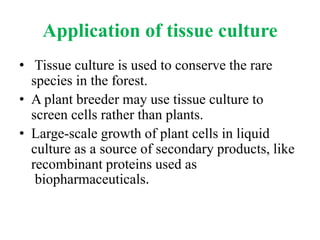
Tissue culture is used to develop thousands of genetically identical plants from one single parent plant known as somaclones and this process is known as micropropagation. The egg is then stimulated and in some cases it starts to divide. For instance with micropropagation methods a clone can be created from just a tiny leaf bud or root segment of the mother plant.
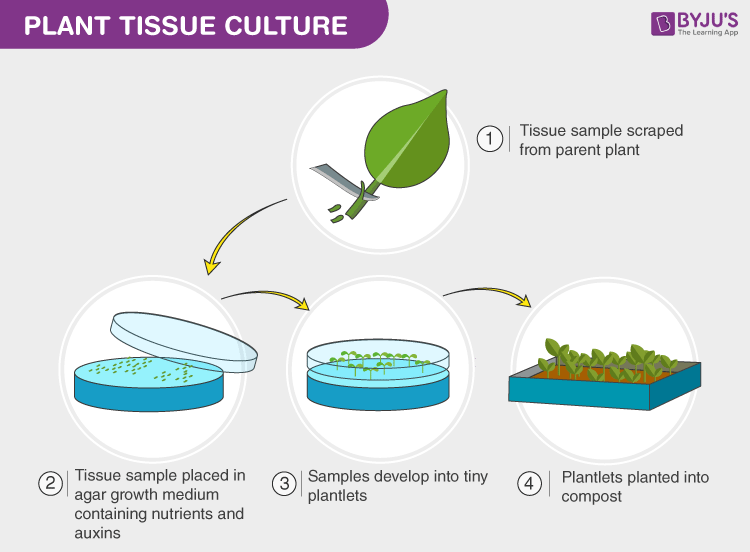
It is widely used to produce clones of plants and the method is known as micropropagation. Explant sterilised and placed in nutrient growth medium has glucose for resp growth factors such as auxins. This technique is helpful in the production of selected plants of known desirable agriculture qualities.
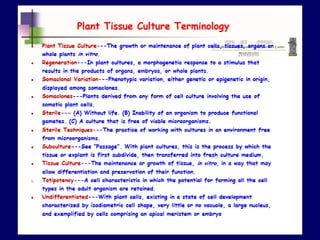
Plants are grown in test tubes. While fragments of a tissue are often used it is important to note that entire organs are also used for tissue culture purposes. Plant tissue culture is a method of asexual reproduction used to produce clones of a plant with desirable traits.
For its part tissue culture boasts. Other than plant tissue culture various methods of gene transfer are also necessary to obtain transgenic plants Kaur et al 2011. When we say plant tissue culture what were really talking about is micropropagation.
Tissue culture plays a critical role in the genetic transformation of a plant species because the first requirement for most gene transfer systems is efficient regeneration of plantlets from cells carrying a foreign gene. Therapeutic cloning produces embryonic stem cells for experiments aimed at creating tissues to replace injured or diseased tissues. A small part of the plant is allowed to grow on a nutrient medium containing all nutrients and hormones necessary for the plant growth.
The application of this technique is based on the observation that a single shoot tip when cultured on an appropriate nutrient medium develops large number of shoots identical to. However extracting the meristem regions of the plant is difficult time-consuming and requires expertise. Gene cloning also known as DNA cloning is a very different process from reproductive and therapeutic cloning.
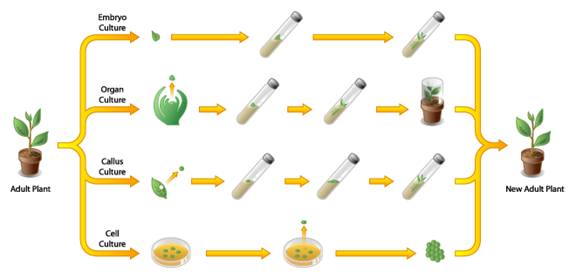
Some common methods of cloning plants involve cutting grafting layering and tissue culture. Process of tissue culture. It works with small pieces of plants called explants.
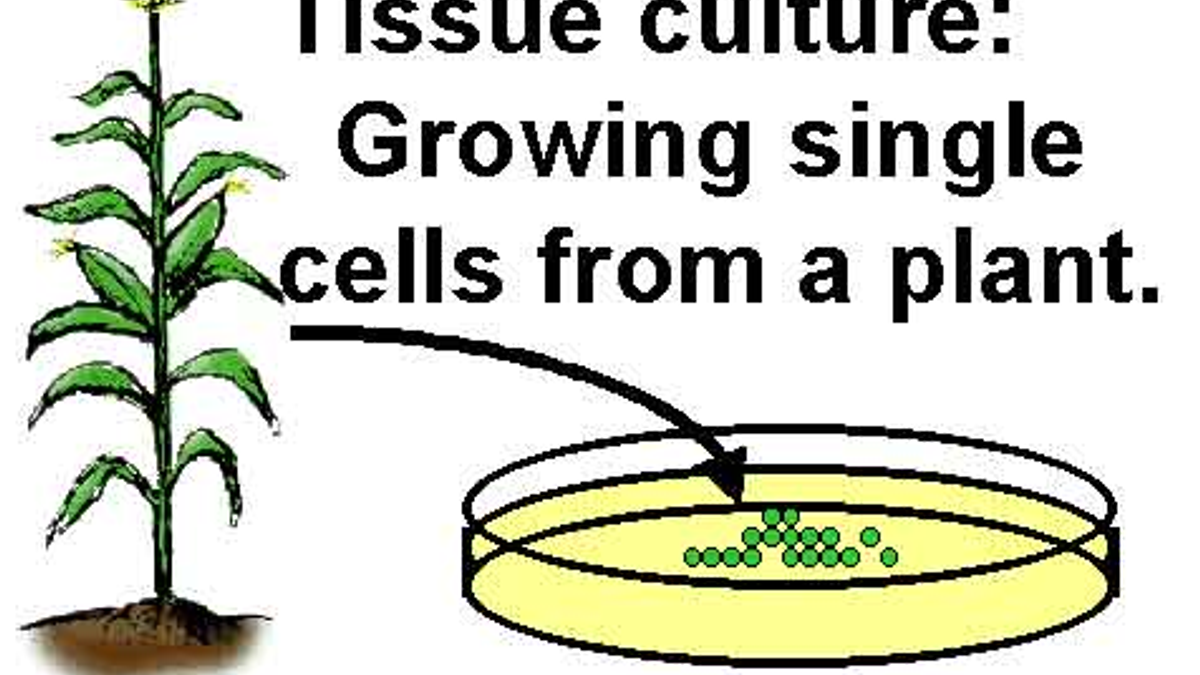
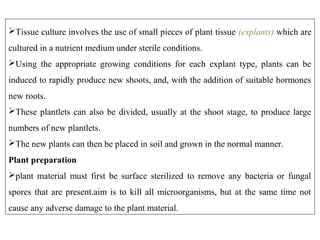
Take explants from the parent plant transfer to plates containing sterile agar jelly add plant hormones to stimulate the plant cells to. It produces exact copies of itself known as clones. The production of plants by the method of tissue culture is also known as micropropagation because a small amount of plant material is used.
The cells of the plants can be genetically altered to produce plants with desirable characteristics. Tissue culture Another way of cloning plants is by tissue culture. Describe the process of plant cloning by tissue culture.
Plant tissue culture is being used to supplement the existing methods of sexual and asexual reproduction. The most common method of cloning plants and the one that has been used for a very long time is that of taking cuttings from an adult plant. In biological research tissue culture refers to a method in which fragments of a plant or animal tissue are introduced into a new artificial environment where they continue to function or grow.
This method is useful for impoverished countries trying to enhance agricultural productivity private at-home growers looking for consistent quality and enterprises looking to make exact clones of a species for profit. Plant tissue culture is a practice of propagating plants under sterile conditions often to produce clones of a plant. Its also used to preserve plant genetics.
Thus are referred as clones. The term clone is used to describe morphologically and genetically similar individuals. The process is widely used to produce plant clones using a method known as micropropagation.
For instance with micropropagation methods a clone can be created from just a tiny leaf bud or root segment of the mother plant. The secret to plant tissue culture is using sugar as an. Cloning which is achieved by inserting clippings from a strong mother plant into a nutrient-rich potting mix often inside a propagator and assisted by the use of rooting hormones is a tried and tested solution.
Plant tissue culture may be used for genetic modification of a plant or simply increase its yield. The method offers an advantage over other methods as it can be used to develop disease free plants from disease-rode plants by using their meristems apical and axillary as explants. Therefore after achieving certain number of meristem plants obtained from these meristems are multiplied using tissue culture techniques for commercial production.
Dedicated mother plants are eliminated and new plants are generated in jars or from their rooted plants thereof. Micropropagation is a form of cloning plant tissue on a very small scale and I mean very small. Micropropagation is a form of cloning plant tissue on a very small scale and I mean very small.
A cutting is a. Plant tissue culture relies on the fact that plant cells have the ability to regenerate a whole plant. Cells taken from plant to be cloned usually from root or shoot tip as these are stem cells - called an explant.
Growers have discovered the secrets that the horticulture industry has known for decades that plant tissue culture is the most efficient method of producing pest-free clones. Meristem culture technique is widely used for obtaining virus-free plants. This technique utilizes the plants ability to rejuvenate the tissues rapidly.
Produces a large number of plants from small pieces of plant in relatively short periods of time under controlled disease-free conditions.

Our Micropropagation Laboratory Filled With Paulownia Plants Underground Greenhouse Hydroponics Propagating Plants

Tissue Culture Cell Culture Toxicology Testing In Vitro Ppt Video Online Download

Plant Tissue Culture
Plant Tissue Culture Ptc
What Is Tissue Culture And Its Advantages In Plants

Plant Tissue Culture Used For 1 Micropropagation 2 Regeneration Ppt Video Online Download
Plant Tissue Culture

Chapter 3 Plant Tissue Culture

I Was Just Asked About Organic Tissue Culture And If The Materials In The Tissue Cultures Were Organic I Answered Plant Tissue Propagating Plants Propagation

Plant Tissue Culture An Overview Sciencedirect Topics
Pdf General Techniques Of Plant Tissue Culture
Plant Tissue Culture
Plant Tissue Culture
Tnau Agritech Portal Bio Technology

Plant Tissue Culture Used For 1 Micropropagation 2 Regeneration Ppt Video Online Download

Chapter 3 Plant Tissue Culture
Plant Tissue Culture Types Techniques Process And Its Uses
Five Methods Of Micropropagation Plant Cell Technology Your Partner In Plant Tissue Culture
Plant Tissue Culture


Comments
Post a Comment